
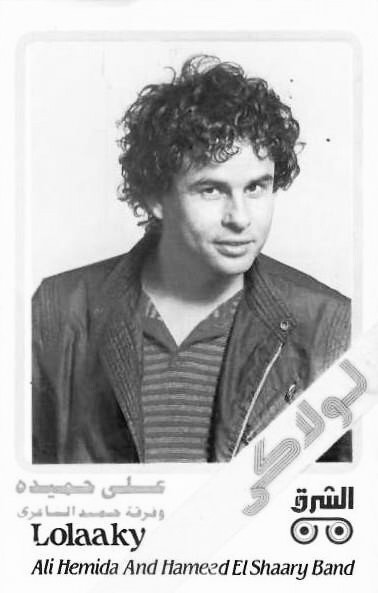
 By
ByFrom a Shepherd in Egypt’s Western
Desert in 1988 to a Legendary Singer of His Era — and a Fierce Rival to Michael Jackson in the Land of the Rich, the United States.
His song “Lolaky” topped global sales charts, selling six million copies, surpassing Michael Jackson’s album by two million copies.
In the same month, he was named Singer of the Month by The New York Times, catapulting him to international fame with just his first album.
But “Lolaky” also became his worst nightmare — the beginning of a tragic downfall that led to his poverty and misery until his death.
So who was the shepherd whose song forever changed Arabic pop music?
“Lolaky” turned into a curse for singer Ali Hemida, who released it in 1988. Born in Marsa Matrouh, on Egypt’s western desert near the Libyan border, Hemida began his life as a shepherd, deeply influenced by Bedouin folk music. He later joined a local musical troupe, but desert life brought no fame among the flocks.
Seeking stardom, he set his sights on Cairo — the “Hollywood of the East”, a city known for making stars out of dreamers.
Ali Hemida began his musical journey in Cairo performing classic Egyptian songs at weddings and small events, using his distinct Bedouin voice. But his early attempts failed. Determined to break through, he decided to create a song that sounded strange and unfamiliar to Egyptian ears — unaware that it would become the song that forever changed Arabic music.
At the time, Egyptian classical songs were long and slow, often lasting 10 to 15 minutes. The music would begin with an extended instrumental introduction before the singer’s voice appeared. Legendary artists like Abdel Halim Hafez and Umm Kulthum dominated this traditional style through the 1970s.
But Hemida did something no one had done before. He introduced a song that blended Western and electronic music with a fast rhythm — a musical earthquake that shook the Arab world. The public went wild. “Lolaky” could be heard everywhere — in cafés, homes, cars, and on the streets.
“I wanted to make something strange,” he recalled. “Something people would either love or hate — but never forget.” Hamdi said years ago.
Hemida quickly became a superstar and global best-seller, but the hit that made him famous also became his lifelong curse, creating enemies and eventually turning even his fans against him.
The song made me — and it destroyed me,” Hemida once said in a television interview years later. “People refused to see me beyond Lolaky. They wanted that song to live forever, even if I couldn’t.”
His first enemy was the audience itself — fans who loved “Lolaky” so much that they refused to listen to anything else. When Hemida released his next album, it sold only 600,000 copies, a fraction of his earlier success. Desperate to revive his fame, he produced and starred in a movie titled “Lolaky”, inspired by his hit song.
Yet Hemida could never convince his audience to embrace new music. They wanted “Lolaky” to live forever.
His second enemies were fellow artists and Egypt’s elite, who viewed his sudden rise with envy. Many wealthy Egyptians looked down on him because of his poor Bedouin background and his humble beginnings as a shepherd.
“One of the most popular talk shows in Egypt said that I was just a Bedouin coming from the desert who didn’t deserve fame. He said this because the song was new and unfamiliar to listeners who were used to classical music. I believe he said it out of fear that the new style of songs would ruin Egypt’s traditional music scene.”
His third and most powerful enemy, however, was the state itself. According to reports, Egyptian authorities deliberately destroyed his career due to his close relationship with Libyan leader Muammar Gaddafi at the time. It’s said that after Egyptian intelligence learned of this connection, they imposed massive, unjustified taxes on Hemida, claiming his hit song had made him excessively rich.
This alleged targeting came amid tense relations between Egypt and Libya, as both countries competed for influence across the Arab world.
Ali Hamida mentioned that he does not deny his friendship with the Libyan president in multiple phone interviews, but he is not the main reason for his downfall. He believes the primary cause was the heavy taxes imposed on him.
After his enemies succeeded in bringing Ali Hamida down, Hamida remained the sole reason Arabic music changed forever. He influenced the fame of singers who are still performing today, such as Amr Diab, who realized that music could evolve quickly by blending foreign musical elements with traditional Arabic music—a key to his success.





Leave a Reply